

The Sixty-Nine UNKNOWNS
- Sunday, August 30 2026 @ 04:23 pm UTC
- Contributed by: masodo
- Views: 192

THE SIXTY-NINE UNKNOWNS
A GlitchyMatrix Assessment of the UNIDENTIFIED Cases in Project Blue Book, 1945–1969
Sixty-nine of 10,808. That is 0.638 percent. The United States Air Force spent twenty-four years processing aerial phenomenon reports from military and civilian observers, applied a classification system with more than a dozen categories, and came back saying we cannot explain this for less than one case in every one hundred and fifty they handled. For every UNIDENTIFIED in the archive, there are roughly 149 cases where they found an answer — weather balloons, aircraft, astronomical objects, radar anomalies. When the answer was available, they used it. When it wasn’t, they filed it.
The GlitchyMatrix Project Blue Book Archive has now completed individual case evaluations for all 69 UNIDENTIFIED-classified files in the 10,808-case declassified archive. Every one. The capstone synthesis — The Sixty-Nine UNKNOWNS — represents the analytical endpoint of that project: what the full corpus actually looks like when you read it carefully, sort it honestly, and stop treating UNIDENTIFIED as a single uniform category. It isn’t.
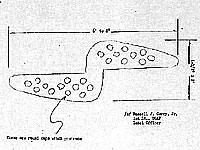 Take Incident #151. Indianapolis, Indiana. July 29, 1948. Two civilians on a routine delivery route crossing a bridge over Fall Creek watch a broad two-bladed propeller-shaped object glide silently at treetop level — 30 feet altitude, 25–30 mph, no sound, no exhaust, no rotation. A military intelligence officer physically searched the wooded terrain. Found nothing. The object’s shape was specific enough that AMC routed the case all the way to General Electric to ask whether their classified Hermes I roto-chute program could account for it. Igor Bensen himself — the device’s designer — reviewed the file and issued a categorical denial. Project Blue Book’s own scientific consultant, Dr. J. Allen Hynek, placed this case in his highest unexplained confidence category: evidence offered suggests no explanation.
Two days later and a few miles away, Incident #152: a cymbal-shaped object, 20 feet in diameter, estimated 1,800 mph, seen for 10 seconds from a kitchen window. Hynek noted that the two Indianapolis incidents — two days apart, same city, similar aspect ratios from different angles — might represent the same object. Nobody followed up on that.
 Or consider Matador, Texas, August 1951. Two women, outside their car on US Highway 70, 125–200 yards from a pear-shaped silver object the size of a freight shed hovering at 150-foot altitude. No sound. No exhaust. No wings. What appeared to be a door or window at its tapered end. The Air Force rated the source A-2 — completely reliable, information probably true — the highest evaluation in their system. Multiple OSI field investigators. Multiple independent character checks. Consistent accounts across every retelling. The investigators correctly ruled out balloon. Nothing else fit either. The case file evaluator wrote, after everything had been checked: the transition from slow low-altitude drift to rapid circular ascent in seconds is not a property of any known aircraft, balloon, or atmospheric phenomenon.
This is what the archive looks like at its best: meticulous field work, high observer credibility ratings, wind data, balloon exclusion by confirmation, and still no answer. The GlitchyMatrix evaluation corpus has worked through 69 cases like this one — sorting which UNIDENTIFIED designations were earned through rigorous elimination, which were administrative defaults for thin data, and which were frankly wrong in either direction.
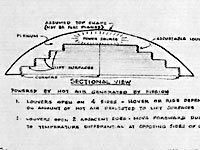 Then there is Washington D.C., December 13, 1961 — Hynek called it the Diamond Case. A 44-year-old Navy flight instructor with nine years of aviation experience stood on E Street NW and watched a diamond-shaped object cross directly overhead at 1,200 feet. Completely silent. No navigation lights. No visible propulsion. He ruled out helicopter, blimp, temperature inversion, and sun reflection by name — because those were things his profession required him to recognize. He went back to the same spot afterward and retraced the path. He drew an engineering diagram proposing a propulsion mechanism. He told Hynek he could not reconcile what he saw with any aircraft he knew. Hynek personally followed up, named the case, and left the cause open. A military teletype was filed the following morning. For a man as practiced at providing conventional explanations as Hynek was in 1961, that silence was its own data point.
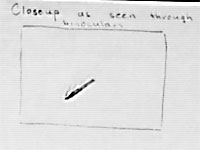 Not every case in the archive is a radar track or a military intercept. Incident #8739, Homer, New York, April 1964 is one of the more unusual evidentiary records in the entire Blue Book collection — not for raw strangeness but for what the witness did to document it. Seven sequential watercolor paintings, each with a dual register: landscape context showing position in sky, inset closeup showing shape detail. One frame explicitly labeled Closeup as seen through binoculars. The binoculars frame shows a dark, tapered, elongated object — no wing, no empennage, no fuselage symmetry. Paintings five and six show the same object transformed into a cluster of five to six spheres of varying sizes, some solid, some fading to outlines. No conventional 1964 aircraft does that. No optical illusion produces five separate spheres where a single tapered form was. The Air Force held the UNIDENTIFIED classification in the 1964 period when the program’s default was to explain everything away. Something about the evidence — and presumably the missing companion narrative — made that impossible.
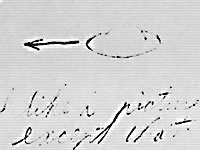 And then there is Pueblo, Colorado, June 14, 1958 — probably the most precisely documented single observation in the corpus. A US Weather Bureau meteorologist with 28 years of theodolite experience was tracking a pilot balloon when an unknown object entered the instrument’s field of view. He timed it with the same precision buzzer he used for balloon measurements. He recorded entry and exit azimuth and elevation. He watched it pass above scattered cirrus, blurring slightly as it did, proving it was above 30,000 feet. It moved from northeast to southwest. Upper-level winds that day ran from the southwest. The object moved against its own wind field. No balloon does 500 mph. No balloon ignores wind. This man had watched balloons through that instrument for 28 years, and he said so directly: It was a material, artificial object, and not a balloon. Watching balloons is part of my regular duties. Captain George Gregory, then directing Project Blue Book, described it as a toughie, ran every check, asked for Hynek (unavailable — he was in Moscow), ran a satellite correlation that came back negative on orbital geometry grounds, and concluded: valid UNKNOWN.
These five cases represent perhaps 15 minutes of reading from an archive of 10,808 files. The full GlitchyMatrix corpus covers all 69 UNIDENTIFIED cases in the same depth — case by case, form by form, witness by witness. The capstone synthesis examines what the corpus shows as a whole: the patterns of silence at close range that no conventional aircraft of the era shared, the wind-vector eliminations that rule out passive aerostatic objects on physical grounds, the radar cases where calibrated instruments tracked things that no human eye had to interpret, and the institutional record of a program that was sometimes rigorous, sometimes imperfect, and occasionally caught revising its own conclusions on retroactive paperwork.
The bottom line: The UNIDENTIFIED cases of Project Blue Book are not uniform. Most reflect administrative default. A meaningful number reflect genuine analytical difficulty. A smaller number — the hard core — are cases where the evidence itself, honestly read, does not resolve. That group is real, it is documented, and it has never been satisfactorily explained. The Air Force closed the program in 1969 and declared there was nothing to see. The meteorologist with 28 years of theodolite experience was not consulted. Neither were the MIT radar professionals, the T-33 pilots who got within 1,000 feet of lights that should have been on radar and weren’t, or the Navy flight instructor who went back to E Street and drew an engineering diagram trying to understand what had crossed overhead.
They filed their reports. The Air Force filed them. The National Archives preserved them. The GlitchyMatrix Project Blue Book Archive published all 10,808, and evaluated the 69 that couldn’t be closed.
Read the full capstone analysis:
The Sixty-Nine UNKNOWNS — GlitchyMatrix.com/bluebook/

All case evaluations, search, and full archive at
GlitchyMatrix.com/bluebook/
All 10,808 declassified USAF UFO case files, 1945–1969
































 Them All!


;)

 After creating the ad block, I had the bright idea to post a screenshot of it to X (formerly Twitter - as if you didn't know that already) with the tagline:Â